
Project Summary
Heycar grew from a German startup into a four-market platform spanning the UK, France, and the Netherlands. I led the redesign of the homepage search as part of a broader effort to unify the experience across countries, and contributed the resulting components to the centralised design system used by every team. Three years on, the design is still live across all four markets.
Responsibility
Research
Wireframes
User Flow
User Personas
UI/UX Design
Prototyping
Tools
Figma
Miro
The Moment Something Felt Off
Buying a car isn't a casual decision. By the time someone lands on Heycar, they usually already know what they want. They have a make in mind, a model they prefer, and a part of the country where they plan to buy.
So when I looked at the homepage analytics, the story didn't add up. We were getting traffic from people with clear intent, and they were leaving without doing anything. The search box, the very thing designed to help them, was where they stalled. That hesitation became the thread I pulled on.
The Wall Disguised As a Search Bar
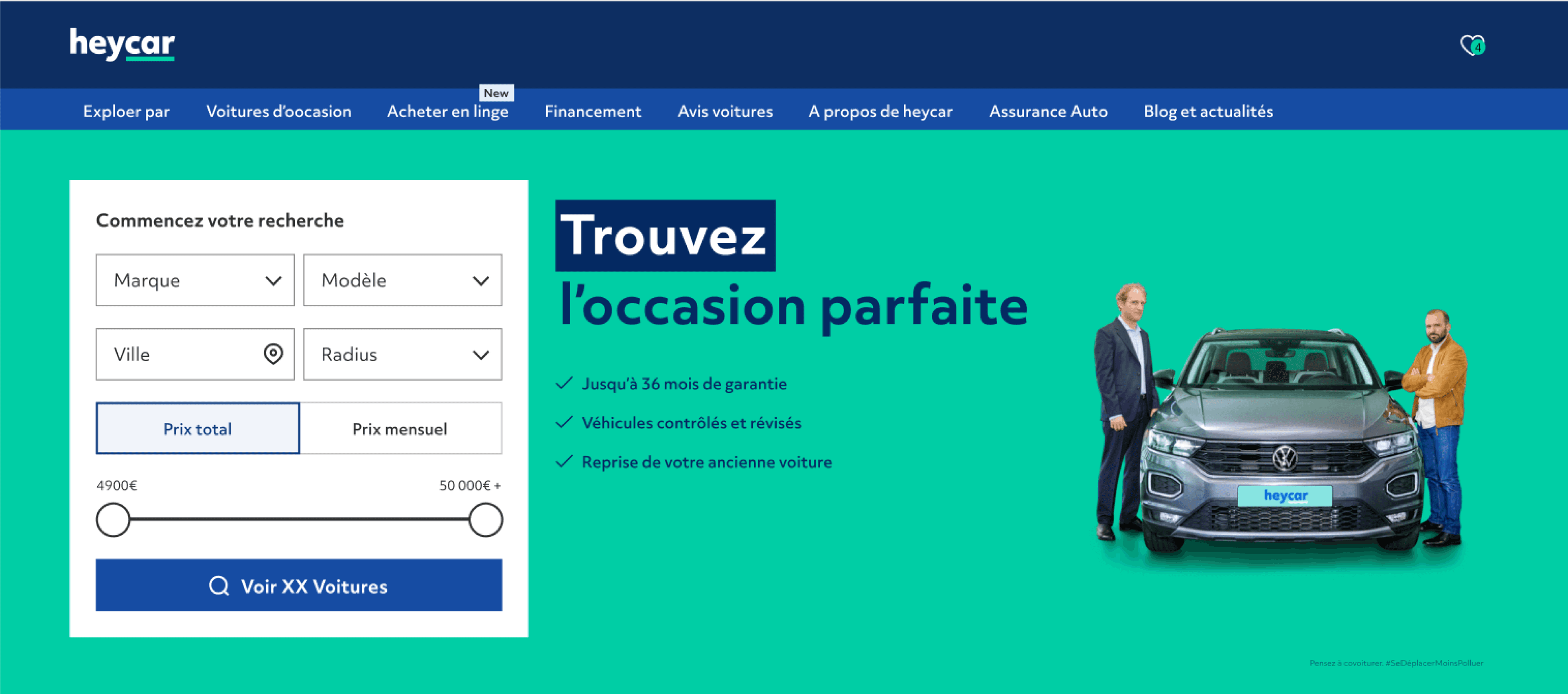
The homepage search asked for five things up front: make, model, city, radius, and a toggle for total price versus monthly price.
The thinking behind it was reasonable on paper. If users could refine their search before hitting submit, they'd land on more relevant results.
In practice, it was a wall.
Five decisions to make before seeing a single car. Five chances to second-guess, to feel unsure, to click away. The funnel numbers confirmed it. High-intent users were dropping off before they ever saw a listing, and the pattern was consistent across markets.
The bet I made early on: the homepage was the wrong place for refinement. Power belongs in the platform, but power at the entry point feels like work. If we moved filtering closer to the moment it actually became useful, after users could see results to refine, we'd convert more of the intent we already had.
The search bar Before:
Make
Model
City
Radius
Total price or Monthly price toggle
Designing For Four Markets At Once
This wasn't just a homepage redesign. It was a redesign that had to work for Germany, the UK, France, and the Netherlands at the same time.
That changed how every decision got made. A component couldn't carry assumptions about postal code format, vehicle data structure, or local buying behavior. It had to earn its space in every context. The constraint sharpened the work. If a field couldn't justify itself in all four markets, it probably couldn't justify itself in one.
Design explorations:
Convincing The Room Before Convincing The User
The first hard conversation wasn't with users, it was internal.
The team's instinct was that more filters meant a more confident shopper. Removing them felt like removing value. And because we were now designing for four markets at once, every decision carried more weight. A change to the homepage wasn't a change to one experience, it was a change to four.
So before any pixels moved, I had to do two things at once:
Find the minimum viable entry point without gutting the platform's depth
Move stakeholders off a "more equals better" prior that had shaped this homepage for years.
I knew design alone wouldn't do it. The case had to come from the data.
What The Research Actually Said
I partnered with the PM on a mix of user interviews and funnel analytics across markets.
Two findings reframed the room.
Most filters were being ignored. Despite their prominence, the radius and price-model toggles saw low engagement on the homepage. Users either skipped them entirely or set them and then immediately changed them on the results page anyway. This held true in every market we looked at.
Three inputs carried almost all the intent. Make, model, and location. Everything else was refinement, and refinement only makes sense once you have something to refine.
That gave me the line I needed in stakeholder reviews. We weren't removing filters. We were moving them to where users were already using them.
How The Redesign Came Together
I started by rewriting the brief. Instead of "redesign the search bar," it became "reduce the cost of starting a search." That single reframe turned search initiation rate into the metric the team rallied around, and made it much harder for new inputs to sneak back in during reviews.
Visual hierarchy mattered as much as field count. The search CTA had been competing with everything else on the page. In the new design, it became the unambiguous next step.
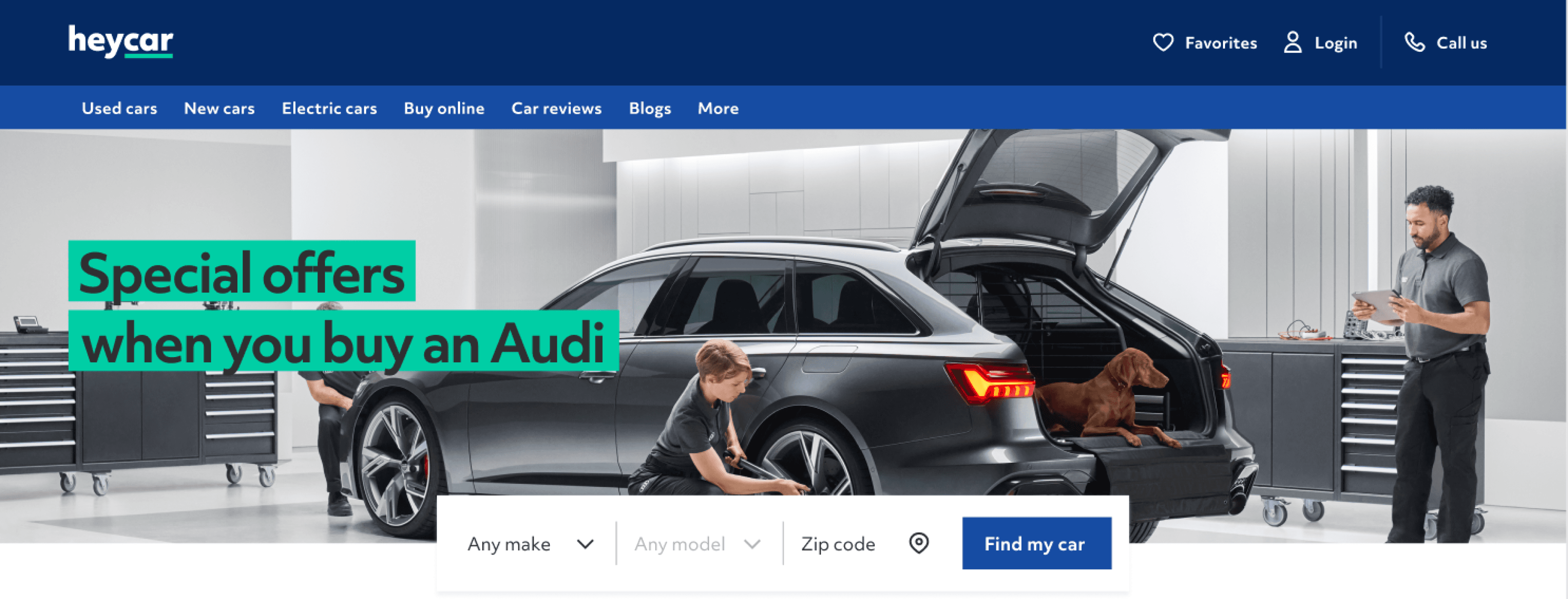
The final move was the one that unlocked alignment. Radius, price model, and the full advanced filter set were repositioned to the results page, where users already had context to use them. Nothing was lost. Things were sequenced.
After:
Make
Model
Zip code
And let the search begin!
Building The Design System
Because this work was part of the broader unification effort, it couldn't ship as a one-off.
The new search bar needed to function as a shared component, used by every market team, while still flexing to local needs like postal code formats and country-specific make and model data.
I worked alongside two other designers contributing to the centralised design system, defining tokens, states, and accessibility behavior for the new search and filter components. Once each component was ready, we handed it off to the dedicated design system engineering team for build.
The upside compounded quickly. The same search pattern shipped across all four markets, and the filter components built for the results page were picked up by other surfaces across the product. A change made for the homepage became a small but durable shift in how Heycar expressed itself everywhere.
Outcomes
Still live across all four markets three years later, having outlasted multiple product cycles and organisational changes
A unified search pattern shipped across Germany, the UK, France, and the Netherlands, replacing fragmented per-country implementations
New reusable components contributed to the centralised design system, adopted by every team and built by dedicated design system engineering
Advanced filtering relocated to the results page, where it sees use in context rather than as a barrier to entry
Stakeholder alignment shifted from "more filters equals more value" to "depth belongs where it's useful"
What I Took From It
Progressive disclosure isn't really a UX pattern. It's a sequencing decision. The real question isn't "what should we show?" It's "when does this become useful?"
Clarity beats comprehensiveness at the entry point. Every input on a starting screen is a tax on momentum. Power users will find depth. First-time users won't push through complexity to find clarity.
And stakeholder alignment is part of the craft. The hardest part of this project wasn't the three-field design. It was building the case that simplification was strategic, not reductive. That took research, framing, and a willingness to defend a smaller surface area against the gravitational pull of "just add it back in."
Reflection
Simplifying a flow takes more discipline than expanding one. It's easier to add a filter than to defend the version without it. But figuring out what belongs at each stage of a journey, and being willing to move things rather than just add them, is where design starts to earn its place in product strategy.
The work is still live today. That, more than any metric, tells me the call was the right one.
© 2026 Nasim Raeesi