
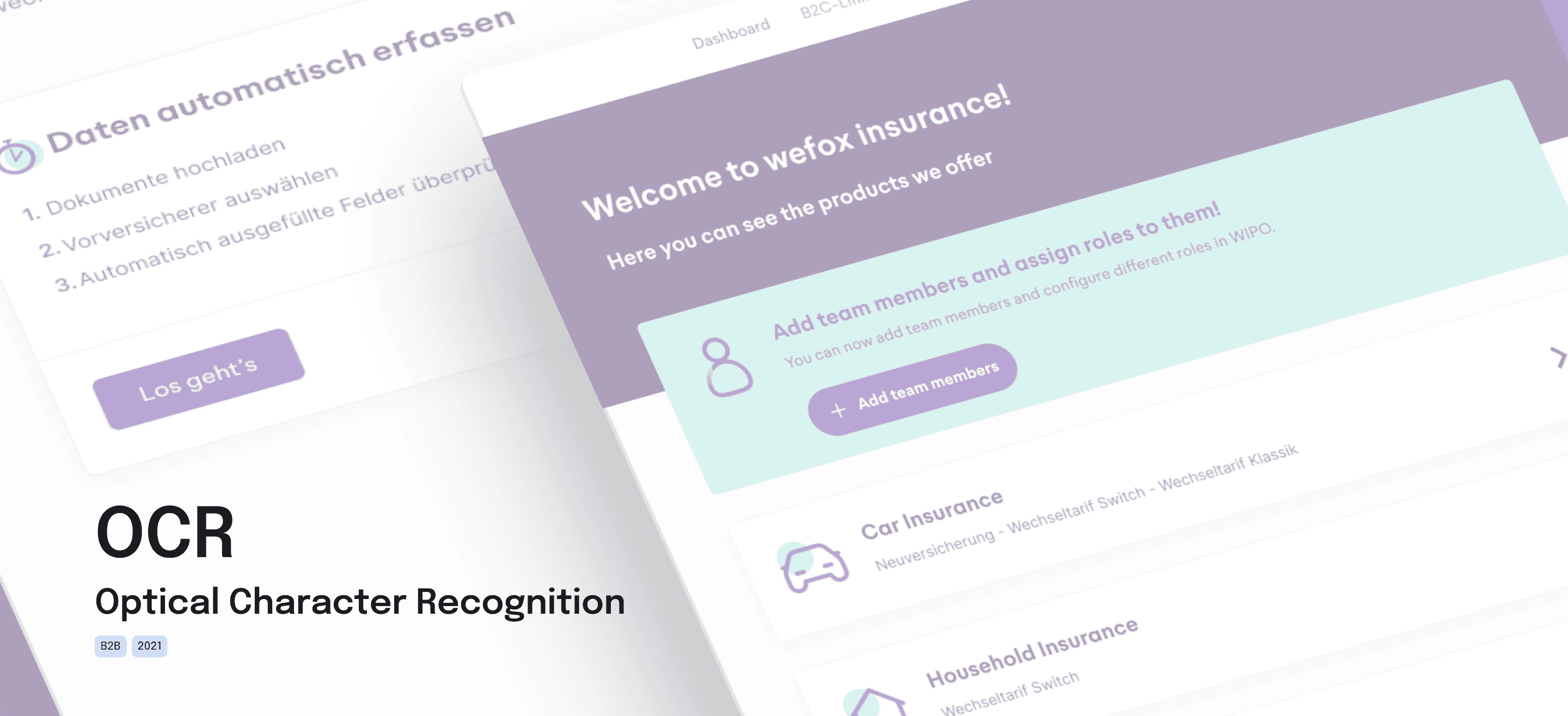
When customers switch from one insurance provider to another, they already have documents containing their basic information. However, insurance brokers had to manually transfer this data into new forms, a slow and error-prone process.
To streamline this, we designed an OCR-powered solution that allowed brokers to upload documents, extract key fields, and auto-fill forms. After a quick review, brokers could submit the form, and the system would instantly calculate a price for the customer.
By introducing AI-driven automation, we aimed to reduce form completion time, improve data accuracy, and enhance broker efficiency.
Research
Wireframe
User Flow
User Personas
UI/UX Design
Figma
Miro
Challenges
Brokers had to manually re-enter customer data from existing documents, leading to delays and errors.
The manual process was time-consuming, slowing down policy switching.
Errors in data entry could result in incorrect pricing or policy issues.
What is OCR?
Optical Character Recognition; is the electronic or mechanical conversion of images of typed, handwritten or printed text into machine-encoded text, whether from a scanned document, a photo of a document, a scene-photo (for example the text on signs and billboards in a landscape photo) or from subtitle text superimposed on an image.
How can OCR help brokers selling insurance faster?
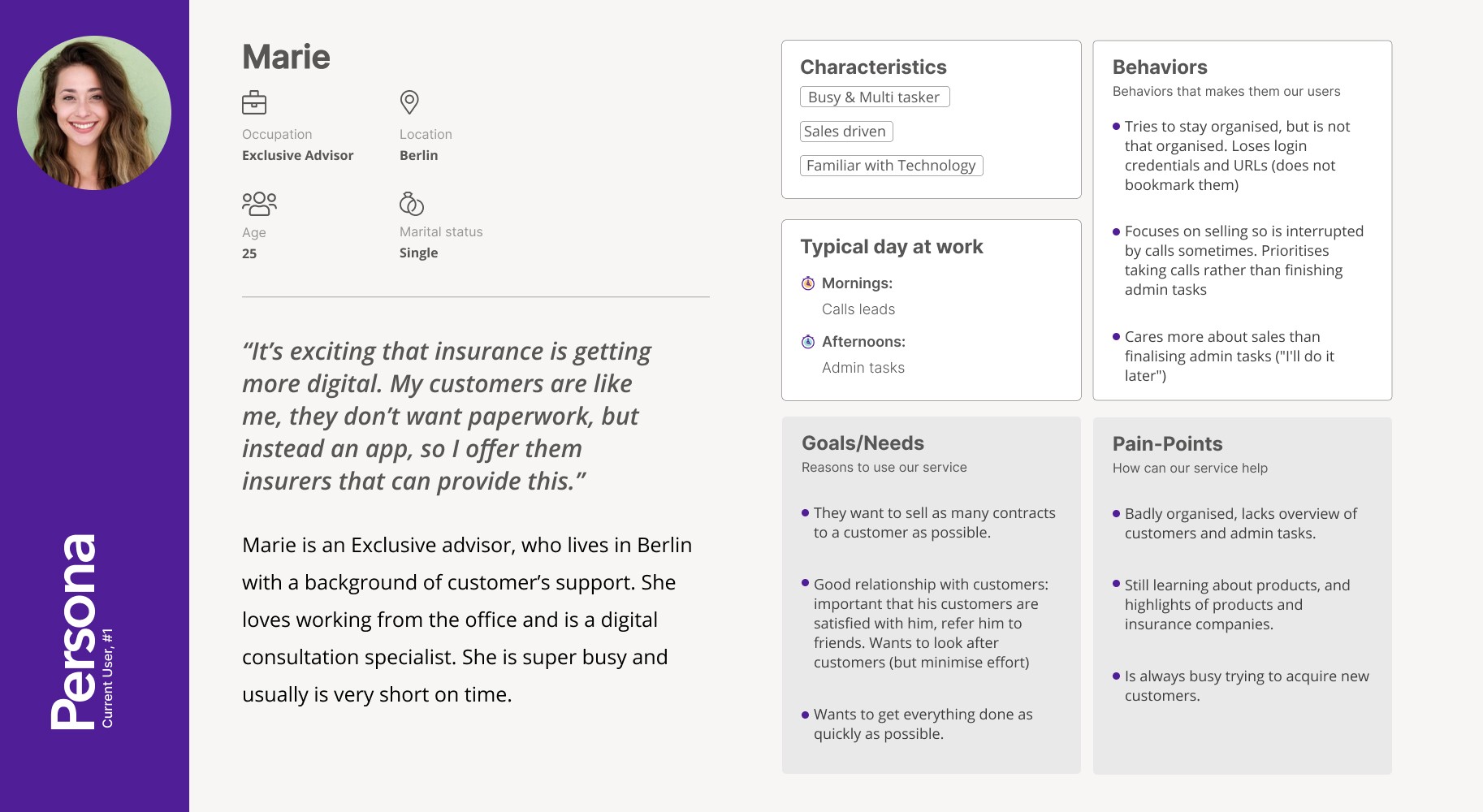
When customers switch their insurance from one company to another, OCR can be handy for brokers during switch season. One of the necessary documents for brokers is the previous insurer document, and this document has most of the customer's data, which a broker needs to fill out the form.
We assumed that enabling brokers to upload this document at the first step would save time and improve data quality by analysing previous insurer documents using OCR and filling switch forms with data for the broker to review.
Objectives
Automate form-filling using OCR technology to extract key customer details.
Reduce time spent on data entry while maintaining high accuracy.
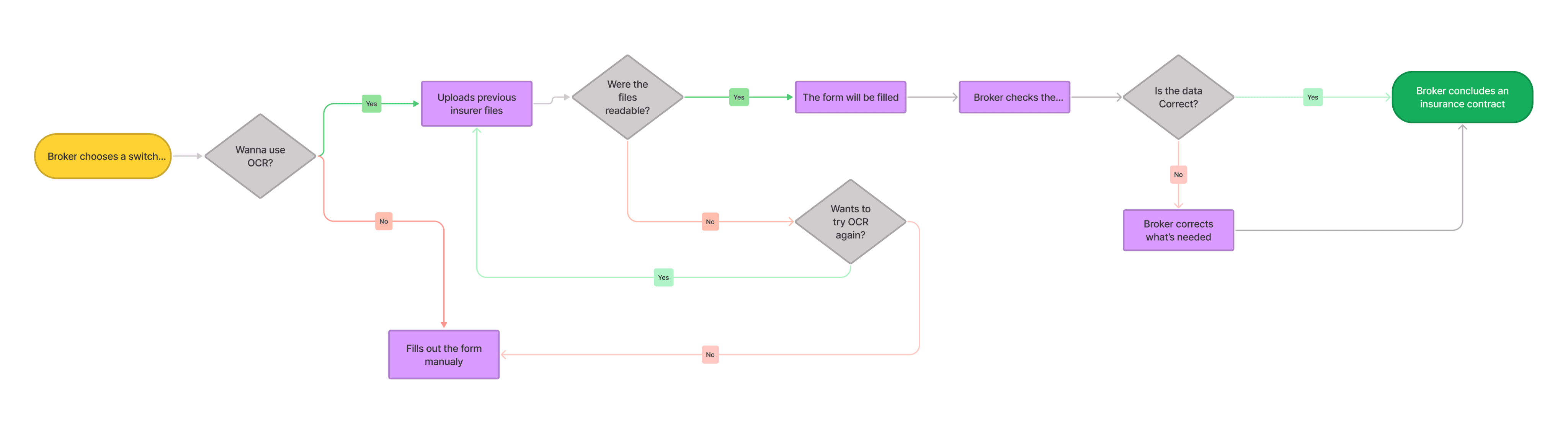
Ensure a smooth transition by allowing brokers to choose between OCR-assisted and manual entry.
Since this was the first AI-powered feature on our platform, we introduced it gradually:
Dual Option Phase: Brokers could choose between OCR-assisted or manual form-filling.
AI Training Phase: Brokers were encouraged to use OCR to train the AI and improve accuracy.
Full Adoption Phase: Once brokers approved the AI’s accuracy, OCR would become the default method for form-filling.
If you are interested in seeing more screens and projects from my time at Wefox, here is a link to its Figma file.
Research & Discovery
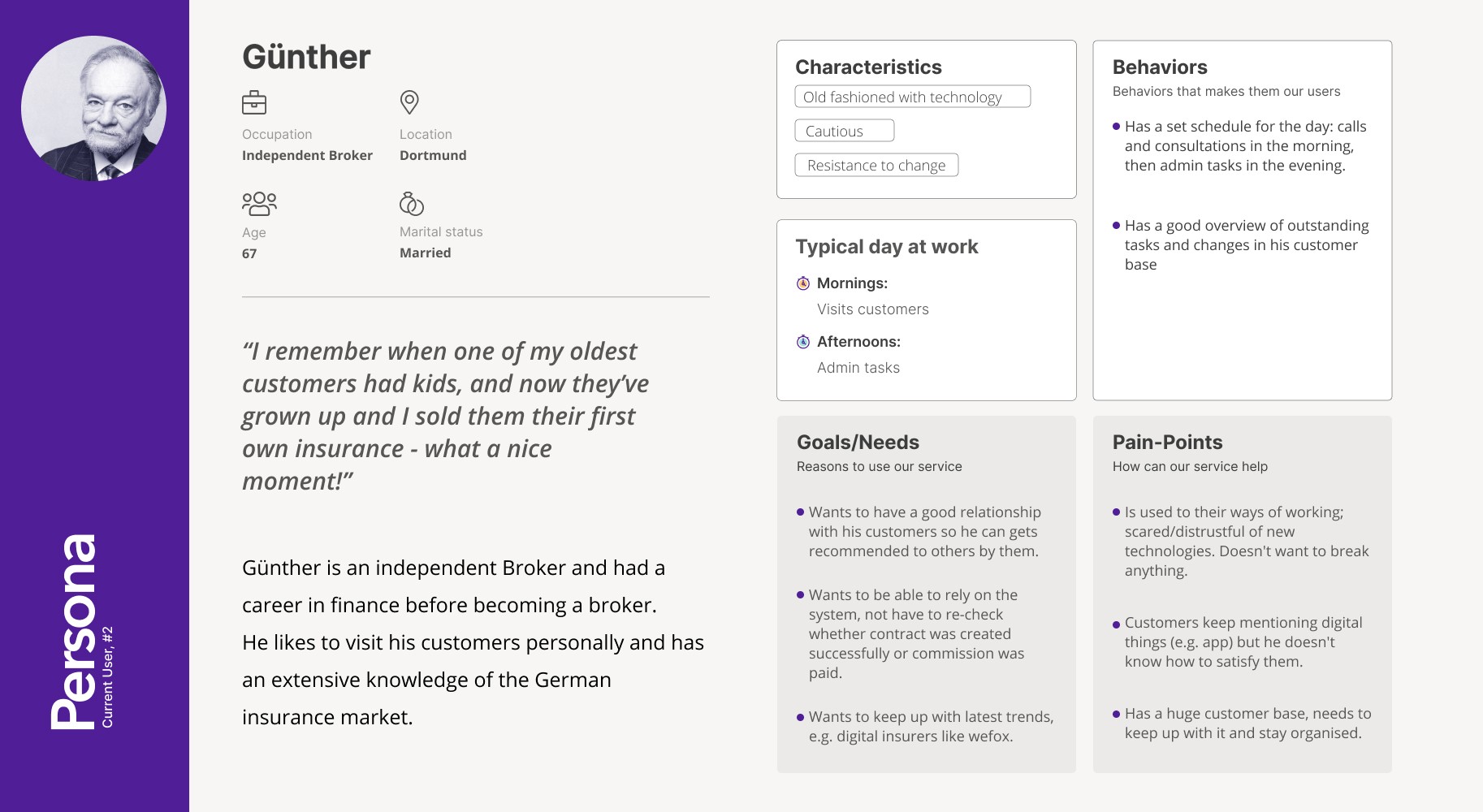
To ensure our solution met broker needs, we conducted user interviews to understand their workflow:
What types of documents do brokers typically request from customers?
What information do they extract manually?
What pain points do they face in form-filling?
Brokers also provided real document samples, which we used to train the AI model and ensure the OCR system could accurately extract key fields.
Prototyping & Initial Testing
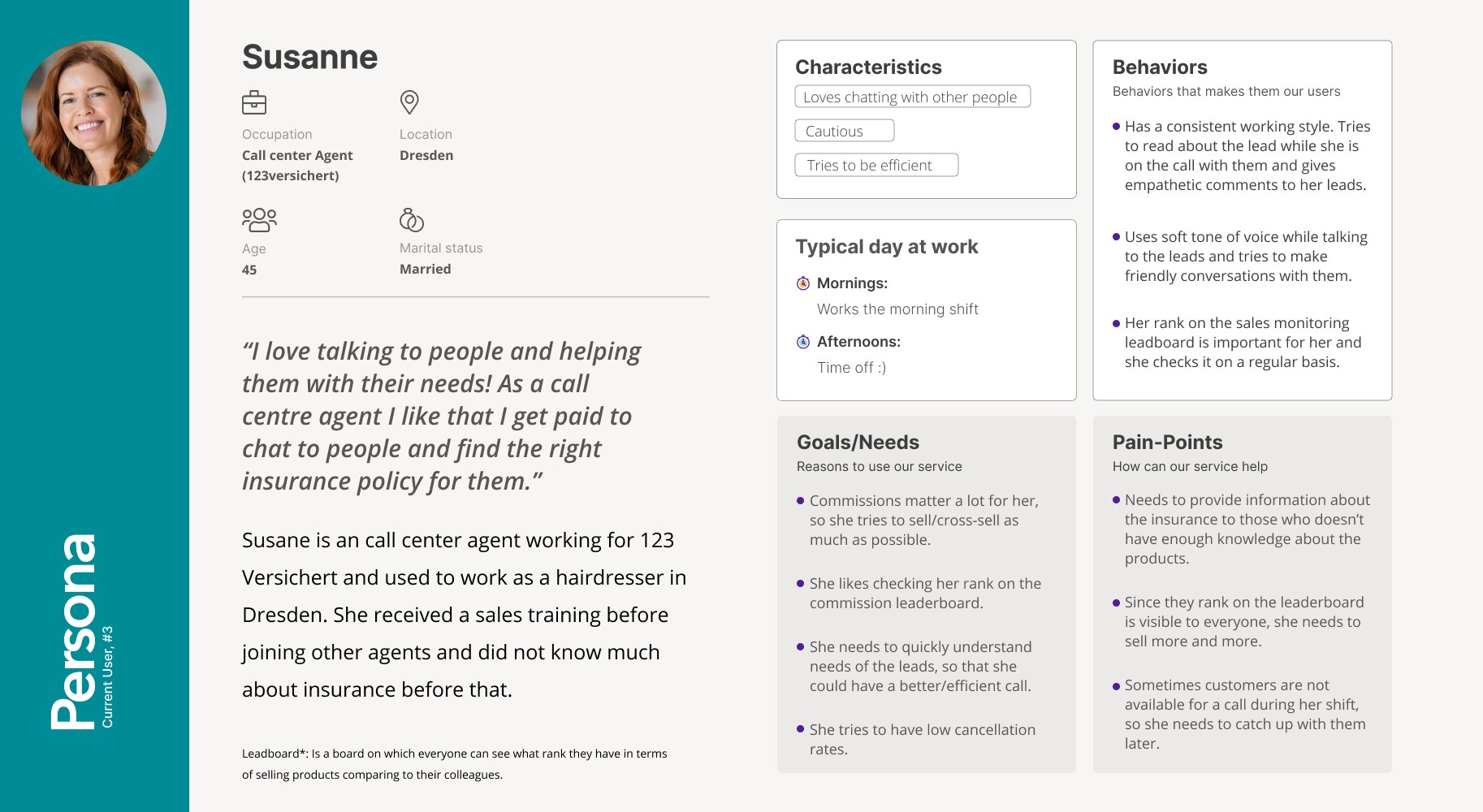
Once we had a prototype, we tested it with three in-house brokers to gather early feedback.
Key Findings from Testing:
What Worked: Brokers liked the idea of reducing manual work.
Challenges:
Processing Time: The OCR system took more than 3 minutes to extract and populate the form.
Accuracy Concerns: Brokers still needed to double-check fields, making the process feel slow.
User Preference: Some brokers preferred manual entry because they trusted their own input over AI-generated data.
Success metrics
Since we needed to train the AI model & it was a bit slow initially, it could have been frustrating for the brokers. So I thought it would be best to introduce two options:
Filling out the form with the help of OCR. In this case, not only could we introduce OCR, but also train the AI.
Filling the form manually. This was there in case the AI wasn't working correctly or for those who don't like change.
This could also count as onboarding for our brokers to OCR. This was the first iteration. Once we saw that most users were using OCR as their primary choice and that it's efficient enough, we made OCR the direct option.
The success metrics we defined for this project were:
Save time for brokers; the time taken to complete OCR flow is less than the manual flow for selling a contract.
Data quality; The time is taken to check data is less than 1 minute.
Iteration & Improvements
Based on broker feedback, we worked on optimizing the experience:
Reducing Processing Time: We collaborated with engineers to optimize the OCR pipeline, reducing form population time.
Improving Accuracy: The AI model was refined using additional broker-approved training data.
Enhancing User Control: We redesigned the review experience, making it easier for brokers to validate and edit fields before submission.
Understand
User Research
User Interview
Competitive Analysis
Define
User persona
User Journey
Ideate
User Flow
Information-
Architecture
Design
Wireframe
Hi-Fi Designs
Prototype
Test
Feedback
Conclusion
Future concept
Faster Form-Filling: The OCR-powered system reduced manual data entry time.
Higher Efficiency: Brokers could now focus on reviewing, rather than typing in data.
Gradual Adoption: By offering both OCR and manual entry options, brokers had time to transition at their own pace.
Once the OCR model reached an acceptable accuracy level, it became the default method for form-filling, marking a major step in AI adoption for our platform.
What we learned:
Balancing Innovation & User Trust: While AI can automate processes, users need time to trust it. Giving brokers control over validation helped with adoption.
Performance is Key: Even if automation is useful, slow response times can discourage users from adopting new features.
Data-Driven Iteration: Continuous training and real-world data were essential in refining the OCR model.
Next Steps:
Continue refining AI accuracy based on real-world broker interactions.
Optimize OCR speed to further reduce form completion time.
Educate brokers on best practices for using OCR to ensure smooth adoption.
This project showed me how introducing automation requires more than technical capability. It requires trust. Brokers needed to feel confident that the system was helping them rather than replacing their judgment. By designing the experience around review and control, we made it easier for users to adopt a new workflow. More importantly, this work laid the foundation for integrating AI-driven features more thoughtfully across the platform.
© 2026 Nasim Raeesi