
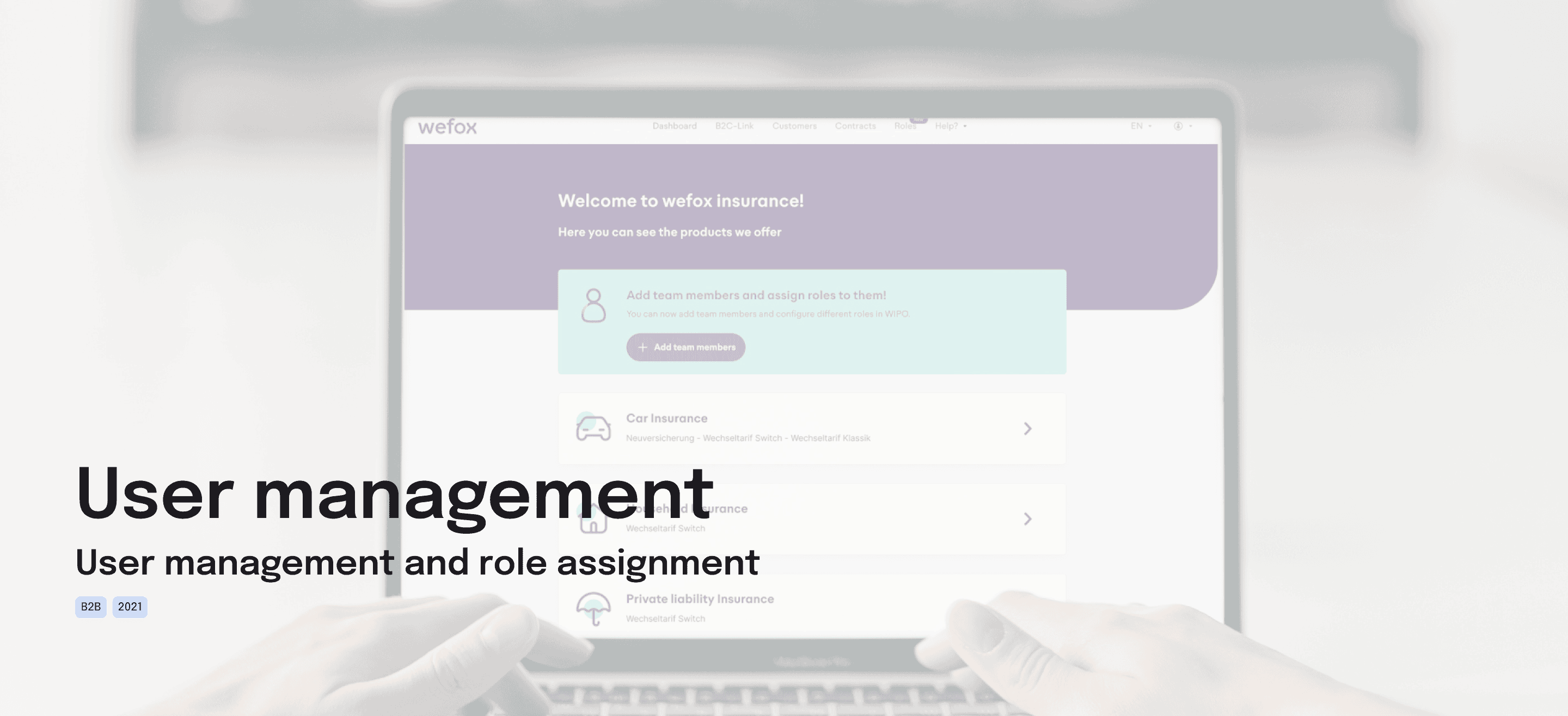
As the WIPO platform matured, it began attracting larger broker companies and not just individual brokers. These organizations relied on structured teams, where different roles carried different responsibilities and access needs.
However, the platform treated every user the same.
To support organizational workflows and unlock adoption from larger broker companies, we introduced a role-based access system. This allowed companies to assign roles, control permissions, and safely onboard entire teams.
This shift transformed the platform from a tool designed for individuals into infrastructure capable of supporting organizations at scale.
Research
Wireframe
User Flow
User Personas
UI/UX Design
Figma
Miro
A bit of context
When the platform was first launched, its primary users were independent brokers. The experience was straightforward. Each user had full access to their own workflows, customers, and data.
But larger broker companies operated differently.
Work was distributed across multiple roles, each with distinct responsibilities. For example:
Brokers focused on selling policies and managing their clients
Senior brokers mentored junior team members while maintaining their own sales
Sales managers monitored performance across teams and identified opportunities for improvement
These roles required different levels of access and visibility.
At the same time, legal and operational requirements meant that certain data needed to be restricted based on role and responsibility.
The platform, however, offered no way to reflect this structure.
And now the problem statement:
Without roles and permissions, the platform created several critical limitations.
Organizations could not safely onboard multiple team members without exposing sensitive information. Managers lacked the oversight they needed to support their teams, while individual brokers were presented with tools and data irrelevant to their role.
This created confusion, reduced trust, and prevented larger broker companies from fully adopting the platform.
What had been sufficient for individuals was no longer sufficient for organizations.
If we wanted the platform to grow, it needed to support teams, not just users.
Our goal was to enable broker companies to manage their teams directly within the platform.
This meant allowing organizations to:
Assign roles to users
Control access to data and features
Reflect their real-world organizational structure
Ensure compliance with legal and operational requirements
From a business perspective, this feature was essential to unlocking adoption among larger broker companies.
Success metric:
Enable at least 10 broker companies with 50+ brokers each to register and actively use the platform by the end of 2022.
If you are interested in seeing more screens and projects from my time at Wefox, here is a link to its Figma file.
Understanding the users
To better understand how broker companies operated, we worked closely with internal advisor teams in Germany and Switzerland. These teams functioned as structured organizations with clearly defined roles and workflows.
Through conversations and workflow analysis, we observed that:
Work was distributed across teams rather than handled by individuals
Different roles required different tools and levels of visibility
Managers needed access to performance data, while brokers needed operational tools
Organizations expected the platform to mirror their internal structure
This reinforced a key insight. Organizational structure was fundamental to how these companies operated. The platform needed to reflect that reality.
Design Challenges
Designing roles and permissions required careful consideration.
The system needed to be powerful enough to support complex organizational structures, while remaining clear and easy to use.
It also needed to ensure that users could understand their level of access, while preventing accidental exposure of sensitive information.
This meant balancing flexibility, clarity, and safety.
Additionally, the system needed to scale as organizations grew.
What we proposed
We introduced a role-based access system within the platform, enabling broker companies to manage their teams directly.
Administrators could invite new users and assign roles during onboarding. Each role defined what users could see and do within the platform.
The interface adapted dynamically based on the user’s assigned role. This ensured that each person had access to the tools and information relevant to their responsibilities.
This approach allowed organizations to safely onboard entire teams while maintaining control and clarity.
The platform now supported both individuals and organizations.
Introducing roles and permissions fundamentally expanded who the platform could support.
Broker companies could now onboard teams with confidence, knowing that access was appropriately managed.
Managers gained the visibility they needed to oversee performance, while brokers could focus on their daily work without unnecessary complexity.
This feature removed a major barrier to adoption among larger organizations and laid the foundation for future enterprise capabilities.
What we learned:
Designing for organizations requires a different mindset
Supporting teams means thinking beyond individual users. Systems must reflect hierarchy, responsibility, and collaboration.
Permissions shape how users experience a platform
Access is not just a technical constraint. It directly affects usability, trust, and clarity.
Infrastructure unlocks future growth
By establishing roles and permissions, we created a foundation for more advanced features, such as team analytics and operational insights.
Next Steps:
Introducing roles and permissions laid the groundwork for supporting broker organizations, but it also revealed opportunities to make the system more flexible and transparent.
One important next step would be enabling custom role creation, allowing companies to define permissions that reflect their unique team structures.
Improving visibility into organizational structure was another opportunity. Visualizing teams, roles, and reporting relationships would help administrators better understand and manage access across their organization.
These improvements would further evolve the platform into a system designed not just for users, but for teams operating at scale.
Designing roles and permissions shifted my perspective from designing for individual users to designing for organizations. Supporting teams required thinking about hierarchy, responsibility, and collaboration across the platform. This work created the structural foundation that allowed larger broker companies to onboard entire teams and opened the door for future team-based features such as performance insights and operational dashboards.
© 2026 Nasim Raeesi